Progressive overload for beginners: when to add weight
Learn what progressive overload means, how to tell when you are ready to add weight or repetitions, and how a simple workout log makes the next step clear.
 JINVO EditorialTraining & product guides
In this article
What progressive overload means
You have been lifting the same pair of dumbbells for a few weeks. The first sessions felt hard. Now you finish every set with room to spare. Is it time to change something, or should you stay where you are?
Progressive overload is the idea behind that question. The ACSM’s 2009 position stand on progression states that progressive resistance training is necessary to stimulate further adaptation toward your goals. It does not mean heavier every session. It means a small, deliberate step when your current workload has become comfortable.
The ACSM’s 2026 resistance-training summary adds a useful balance. Its message is that the best program is the one you will stick with, and it says training to failure is not strictly necessary for general health and fitness. Progressing does not require grinding out every set. It requires noticing when a workout has stopped asking much of you.
Five ways to make a workout a little harder
Weight is only one lever. When your dumbbells jump in big steps, or a heavier pair is not available, another lever may be the better next move.
| Lever | Example | Worth knowing |
|---|---|---|
| Repetitions | Move from 8 to 9 repetitions with the same weight. | Needs no new equipment, so it suits home training. |
| Weight | Use the smallest heavier option your equipment allows. | Check that your technique stays the same after the change. |
| Sets | Add one set to an exercise. | Adds time as well as work. ACSM’s 2026 summary points to about 10 sets per muscle group each week for muscle growth. |
| Harder variation | Move from a wall push-up to an incline push-up, or to a thicker band. | Useful when weights are fixed. |
| Control | Lower the weight more slowly, or add a short pause. | Keep the movement smooth and comfortable. |
Change one lever at a time. If you add weight, repetitions, and a set in the same week, it is hard to tell which change made the session harder.
How to know when it is time to add weight
A widely used guideline comes from the ACSM’s 2009 position stand. When you train at a particular load, it recommends a 2–10% increase once you can perform the current workload for one to two repetitions over the number you were aiming for. For people new to lifting, it suggested loads that allow roughly 8–12 repetitions and training two to three days a week.
Here is how that looks in practice. Say you are aiming for 10 repetitions of a goblet squat with a 10 kg dumbbell. If you finish 11 or 12 repetitions with steady technique, you have met the condition. A 2–10% increase on 10 kg is 0.2–1 kg. Many dumbbells do not come in steps that small, so you might add a repetition or a set first, or choose a harder variation. If you cannot reach your target repetitions yet, keep the weight and try again.
- 01ReachHit your repetition target, plus one or two more, with steady form
- 02NudgeAdd a small step in weight, or one repetition
- 03RebuildExpect fewer repetitions at first, then climb again
The ACSM stand says its recommendations should be applied in context, depending on your goals, physical capacity, and training status. Treat the guideline as a starting point for a conversation with a qualified trainer, not a rule that overrides how you feel on the day.
When to repeat a weight, wait, or step back
Staying at the same weight is a normal part of progress. Repeat the weight if you missed your repetition target, if your technique changed on the last few repetitions, or if the week was short on sleep and time.
Progress is rarely a straight line. A busy week, a trip, or a missed session can make last week’s weight feel heavier. Treat that as information, not failure, and restart from a weight you can control.
Pain is different. Sharp or lingering pain, or anything that worries you, is a reason to stop and talk to a qualified healthcare professional. A guideline or an app cannot assess an injury. A qualified trainer can also help you learn technique for exercises that are new to you.
End each session by writing your next target in one line: “10 kg, aim for 11 repetitions.” You will walk into the next workout already knowing what to try.
Keep a log that makes the next step obvious
Progress is hard to judge from memory. Record the exercise, the weight or band, the sets, and the repetitions you completed. Add one short note about the last repetitions, such as easy, steady, or shaky.
Use the same exercise names every time so your history is easy to compare. Keep the routine itself simple: the CDC recommends muscle-strengthening activity on at least two days a week, covering all major muscle groups. If you are still deciding how often to train, start with our guide to strength training two days a week. If your time is short, see how to plan a 20-minute strength workout at home.
Where JINVO fits into progression
Deciding what to try next is the kind of decision JINVO is designed to help with. It builds training plans around your goals, experience, equipment, and schedule. You can log sets by voice or text, and daily check-ins and weekly reviews add context about how your training is going.
“Last week I did 3 sets of 10 goblet squats with a 10 kg dumbbell, and the last repetitions felt steady. What should I try next time?”
Example prompt. Check any suggestion against your own judgment; a particular response is not guaranteed.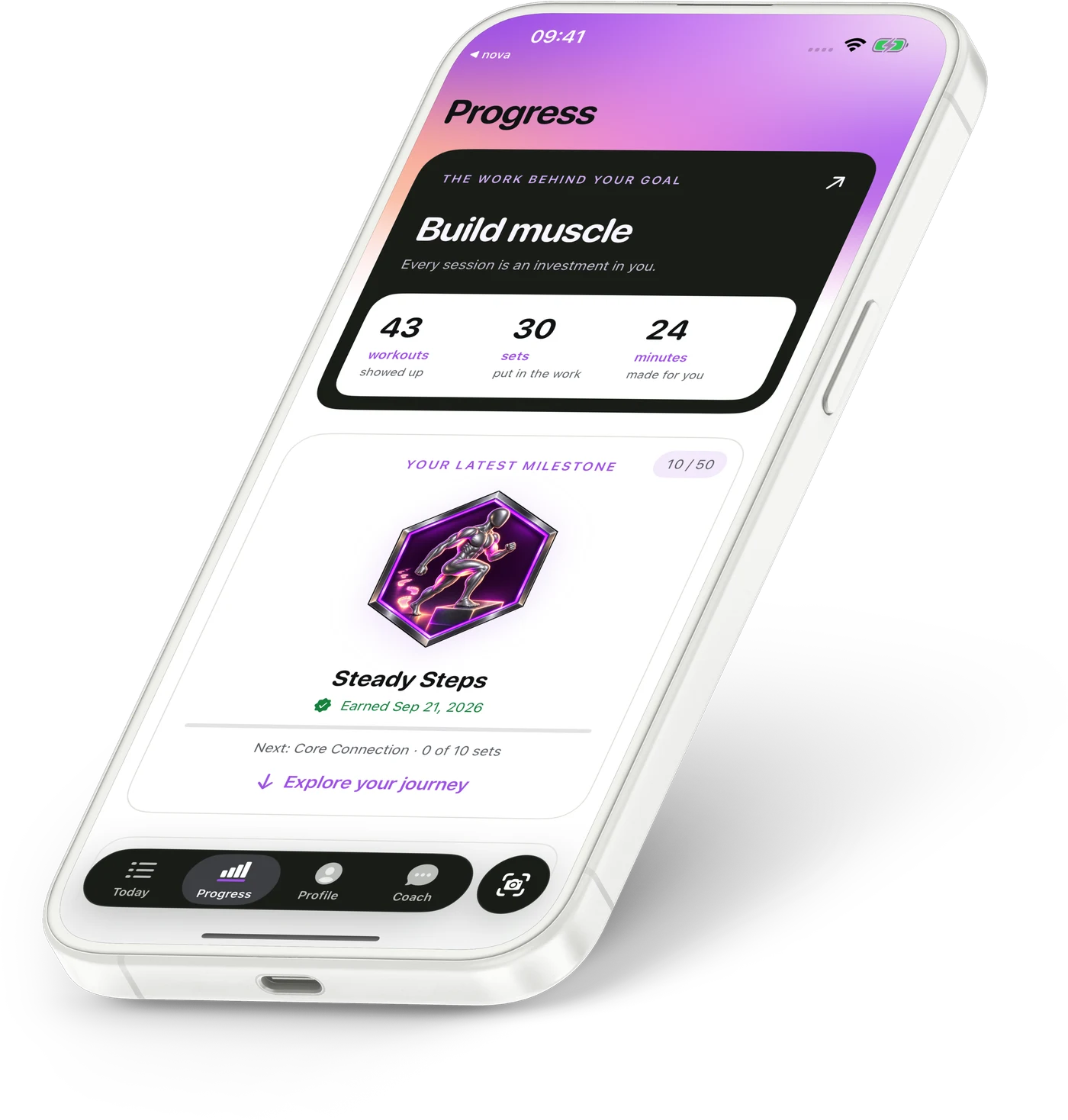
The ACSM’s progression guidance is published research. It is not an endorsement of JINVO, and JINVO’s suggestions have not been clinically validated. Pain, injury, and health concerns belong with a qualified professional.
Want to see how JINVO plans and records your training? Explore how JINVO works. JINVO is coming soon for iPhone with iOS 26 or later. Coaching will require a subscription, with local prices shown in the app.
Frequently asked questions
How often should I increase the weight?
There is no fixed schedule. The ACSM’s 2009 position stand suggests a 2–10% increase once you can complete one or two repetitions beyond your target. If you cannot, keep the weight and try again. Your exercise, technique, and recovery all affect the right pace.
Can I use progressive overload with bodyweight or resistance bands?
Yes. ACSM’s 2026 summary describes elastic bands, bodyweight exercises, and home-based routines as effective. You can progress by adding repetitions or sets, choosing a harder variation, using a thicker band, or controlling the movement more slowly.
Do I have to train to failure to make progress?
No. ACSM’s 2026 summary says training to failure is not strictly necessary for general health and fitness. Stop a set when your technique would change, not only when you cannot do another repetition.
What if I cannot add weight this week?
Repeat the weight, add a repetition or set, or choose a variation. Sleep, stress, and a busy week all change how a session feels. If pain is involved, stop and ask a qualified healthcare professional.
Sources & editorial notes
- ACSM position stand — Progression models in resistance training for healthy adults (2009)Medicine & Science in Sports & Exercise, 2009. Source of the 2–10% load guideline and the novice ranges. It addresses healthy adults and says recommendations depend on goals, capacity, and training status. It predates the 2026 update.
- ACSM — 2026 Resistance Training GuidelinesMarch 17, 2026 summary for healthy adults. Covers consistency, about 10 weekly sets per muscle group for muscle growth, and training to failure not being strictly necessary. It does not set a specific rule for when to add weight.
- CDC — Adult Activity: An OverviewMuscle-strengthening activity on at least two days a week for all major muscle groups. Page last reviewed December 20, 2023.
- JINVO — Product overviewFirst-party information about planning, logging, and availability.
Published October 2, 2026 by JINVO Editorial. External sources checked on this date. JINVO publishes these guides as the app’s developer; product descriptions are first-party information, not independent reviews. Examples and illustrations are not research results.
General educational guidance for adults. For pain, injury, or questions about exercise suitability, consult a qualified healthcare professional. A qualified trainer can help you learn unfamiliar movements.